
Lost
Nov 2024
Dev Engine
Unreal Engine 5
Role
Game Designer | Level Designer
Genre
Psychological Horror, Narrative, First-person
Lost is a prototype that explores spatial puzzles and psychological tension by synthesizing mechanics and aesthetics from several genre-defining titles. The foundational chrono-phasing gameplay was heavily influenced by the time-travel mechanics in and the "Crack in the Slab" mission in Dishonored 2. To elevate the eerie, psychological dread, I drew atmospheric inspiration from the surreal, collapsing environments of Control and the Layers of Fear franchise. Furthermore, the overall tension-building and pacing are structured around the claustrophobic layouts characteristic of classic survival horror.
Game Length ~ 7 min
Game Highlight
Level Design
+ Puzzle solving featuring time travel mechanics
+ Integrating narrative design into the environment
+ Use Zelda Cam to guide the player
+ Use narrative fragments scattered throughout the linear levels to introduce the story
Inspiration

Lost was originally conceived as a first-person psychological puzzle-adventure. My goal was to synthesize the mind-bending spatial logic of Control and the time-travel mechanics of Titanfall 2, while wrapping it all in the oppressive, disorienting atmosphere of the Layers of Fear franchise.
To ground the psychological tension, I anchored the visual identity and moodboards in the concept of Liminal Spaces. By trapping the player in an intricate, indoor labyrinth comprised of transitional, eerily empty architecture, the environment itself evokes a profound sense of isolation and unease. Choosing a free-look first-person camera was a deliberate decision to maximize this immersion and push my own boundaries in spatial design.

The gameplay loop is built around a Chrono-Phasing time travel mechanic. Players must solve puzzles by jumping between two distinct time periods within the same space. From a level design perspective, this meant constructing two overlapping maps with identical layouts but distinct environmental storytelling and material variations.
Navigation & Indirect Narrative I intentionally designed the maze to make players feel disoriented, challenging them to fully explore every corner to deduce the true exit. However, to prevent frustrating dead ends, I planned a system of subtle environmental indicators to confirm progression. Narrative takes a backseat to gameplay; the lore is delivered indirectly, akin to Soulslike item descriptions, which ensures that the spatial logic and chronological puzzles remain the dominant focus of the experience.
Level Breakdown

After I've studied the mechanics from Titanfall 2 and Dishonored 2.... To implement the core Chrono Phasing mechanic, I architected two structurally identical levels overlapping on different Z-axis values. While they share an identical spatial footprint and geometry, I utilized distinct material variations and lighting schemes to distinguish between the two timelines, creating such a simple logical solution for a multi-dimensional system.
The map is strategically segmented into three primary zones to manage player pacing and mechanical mastery:
The left part, tutorial level
-
This sector serves as a controlled sandbox for players onboarding. It introduces the full suite of gameplay mechanics, including the Zelda Cam (or may be cinematic cutaway) system for interactive door switches and the foundational logic of ChronoPhasing puzzles.
The Central Core
-
As the primary gameplay hub, this section reinforces the initial mechanics while introducing higher stakes survival horror elements. Players must navigate central square spatial puzzles while evading patrolling anomalies that actively drain their Sanity. This will force a balance between logical problem-solving and environmental awareness.
The Right Wing
-
The final segment is designed as the project’s emotional payoff. Through intense, escalating audio cues and synchronized environmental lighting, the level pushes the player toward a tensioned psychological peak, culminating in the final puzzle and a desperate escape sequence.
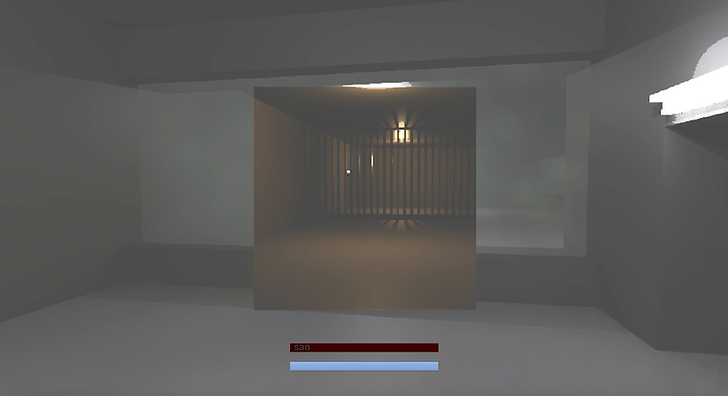
Upon entering the level, the player is introduced to the Chrono Phasing window, which is a realtime interface activated via the E key that reveals the hidden topography of the alternate dimension.
The opening challenge is a layered obstacle set where a physical barrier is impassable in the current timeline but absent in the other. By clearing these two initial gates, the player internalizes the core logic of Chrono Phrasing mechanics through their experience.
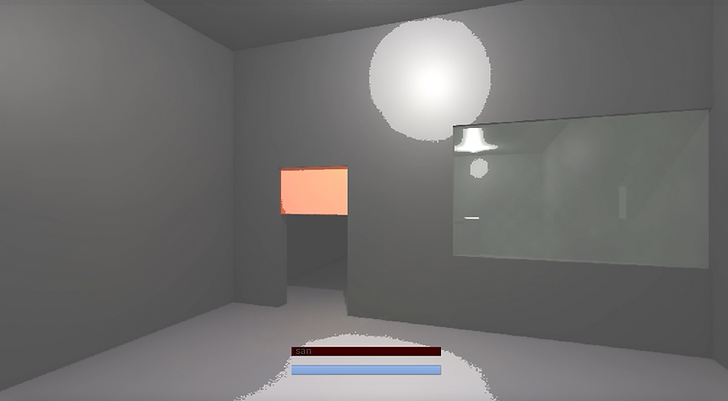
After navigating the initial obstacles to reach the interactive console in the right wing, players encounter the debut of the Zelda cam cutaway.
I implemented a signature auditory cue as a new door opened. The distinct beeping sound creates a sensory anchor that can reinforce the player’s success game feel.

When the player enters the central area, the gameplay shifts toward a high-stakes balance of movement and evasion. Players must utilize chrono phasing to traverse fractured, uneven terrain while simultaneously managing stealth to avoid patrolling anomalies. This section introduces intentional navigational friction, forcing players to engage deeply with the spatial logic of both timelines while under constant psychological pressure.
The architectural centerpiece of the square corridor is a transparent telephone booth. This served as a primary POI. Meanwhile, a persistent, ringing telephone acts as an auditory beacon and narrative hook, driving the player to solve the spatial riddle of how to reach the center.
Exploration of the corridor leads players to a basement entrance, which serves as a mechanical gate. Accessing this sub-zone requires the precise application of chrono phasing puzzles, reinforcing the project’s core mechanical logic and resetting the pacing before the final, high-tension sequence.
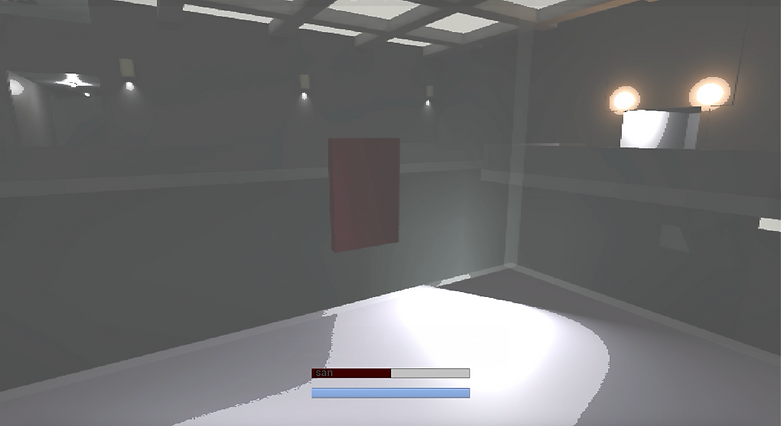
Resolving the basement’s spatial puzzles serves as the mechanical trigger for the final transition: the activation of an elevated walkway/lift leading directly to the central telephone booth. This architectural shift acts as the Point of No Return, moving the player from a state of methodical exploration into the heart of the anomaly.

Before reaching the final chamber, players must traverse a constrained, linear corridor designed to function as a pacing accelerator. This transition is no longer about exploration but about survival. I used a combination of auditory and visual stimuli to create a sense of urgency, ensuring the player felt the anomaly closing in.

The experience culminates in a high-stakes spatial puzzle within the level's final chamber. This encounter introduces a strict time-pressure mechanic, where the player’s remaining Sanity serves as their primary resource. Success requires the player to execute their internalized knowledge of the chrono phasing system under duress, finding the solution before Sanity is depleted.
Once the final puzzle is solved and the player steps into the last corridor, the game undergoes an atmospheric shift. The pursuit SFX that had been relentlessly pushing the player will gradually fade into a heavy, unsettling silence. This transition from high decibel chaos to absolute quiet serves as a narrative catharsis, signaling that the immediate threat has passed while leaving the psychological weight of the journey intact.
Technical Postmortem
The Chrono Phasing System: Technical Implementation
The core challenge was providing the player with a seamless, real-time preview of an alternate timeline. I engineered a solution using a dual-level topology:
-
Z-Axis Geometry: I constructed two structurally identical levels oriented perpendicularly and offset along the Z-axis. This allowed for perfect spatial synchronization between the Present and the Past.
-
Real-Time Preview Window: Inspired by the timepiece in Dishonored 2, I configured a Scene Capture Component attached to a duplicate player actor in the alternate level.
-
Render Target Projection: The camera feed from the alternate level was projected onto a Render Target, which was then displayed on a plane within the player's First-Person Character Blueprint.
-
Dynamic Transform Syncing: By continuously updating the transform and location data of the duplicate actor in real-time, I ensured the preview window provided a frame-accurate, 1:1 representation of the destination before the player committed to a phase-jump.
Systemic AI & Stealth Logic
Beyond spatial puzzles, the level features a patrolling anomaly, which is an SCP-inspired entity that serves as the primary threat.
-
Controlled AI Logic: To maintain stability and precise control over the encounter, I opted for a streamlined AI architecture. Rather than utilizing complex Behavior Trees, I scripted the enemy logic using Move AI To nodes within a four-point patrol loop.
-
Variable Management via Macros: I implemented custom Macros to store and access patrol coordinates. This approach allowed for rapid iteration and direct access to movement variables, ensuring the AI remained responsive to the player’s presence (sensing and chasing) while keeping the backend logic clean and scalable.
Atmospheric Guidance & Environmental Narrative
My design philosophy for Lost was to minimize explicit UI and maximize organic player guidance.
-
Sensory Cues: I utilized flickering lights and directional audio—specifically a ringing telephone at the level's center—to act as Visual/Auditory Beacons. These elements provide a non-verbal roadmap, pulling the player toward the central Hub and hinting at the progression path without breaking immersion.
-
Iterative Geometry: The vertical layout was a deliberate constraint to ensure that the "jump" mechanic felt physically grounded. By maintaining identical map boundaries across the Z-axis, I prevented navigation errors and ensured that the player’s transition between timelines remained fluid and predictable.
Reflections & Design Pivot
While the technical foundation was robust, the most significant lesson learned was the importance of Pacing. Early playtests showed that overly complex puzzles could stall the psychological tension. This led to a pivot: focusing on the simplest logical solution for the player's journey, ensuring the technology (Chrono Phasing) served the horror experience, rather than distracting from it.